

Blog, Facials, facials, peels, pigmentation, shine skin solutions
What Is Melasma? Everything You Need to Know
Feb
You’ve noticed darker patches on your face. Maybe on your cheeks, forehead, or upper lip. You’ve tried covering them. They keep coming back.
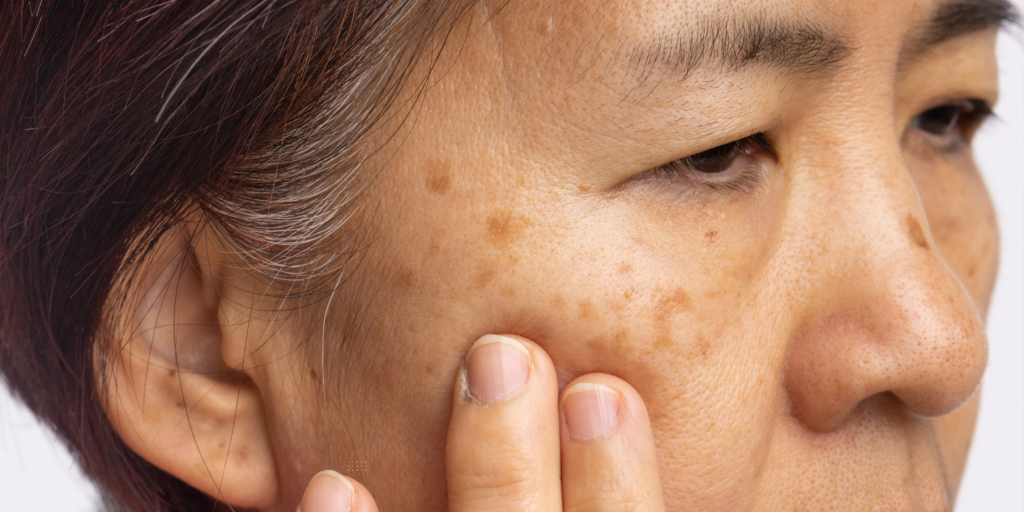
One of the telltale signs of melasma is that it appears symmetrically. If it shows up on one cheek, it usually shows up on the other side too. It follows a pattern across the face rather than appearing as random spots. That mirrored quality is one of the first things we look for at Shine.
You’re not imagining it. And you’re not alone. What you’re likely dealing with is melasma, one of the most common skin conditions we see in clinic, and one of the most misunderstood.
At Shine, we make skin make sense. So let’s break this down.
What Is Melasma?
Melasma is a skin condition that causes patches of darker pigmentation, usually on the face. It most commonly appears on the cheeks, forehead, upper lip, and temples.
The patches are typically brown, tan, or greyish-brown. It affects women far more than men, around 90% of people with melasma are female, and it most commonly develops between the ages of 20 and 40.
What’s Actually Happening in Your Skin?
Your skin contains specialised cells called melanocytes. Their job is to produce melanin, the pigment that gives your skin its colour.
In melasma, those cells become overactive. They produce far more melanin than they should, and that excess pigment builds up to create the patches you can see.
Melasma is strongly hormonal in nature. That’s why it so commonly appears during pregnancy, while on the contraceptive pill, or during periods of hormonal change. Oestrogen and progesterone both stimulate melanocyte activity which is why melasma is sometimes called the mask of pregnancy.
But hormones aren’t the only driver. UV exposure, heat, and inflammation all play a role too. Even when the trigger is removed, the skin keeps signalling those cells to produce more pigment. That’s what makes it so persistent.
Is It Melasma or Sun Damage?
This is one of the questions we get asked most in clinic. They can look similar, but there are some key differences.
Sun damage tends to appear as scattered individual spots with more defined edges. It usually shows up on areas of highest sun exposure and doesn’t follow a pattern.
Melasma tends to appear in larger, more diffuse patches with softer edges. It follows that characteristic symmetrical pattern across the face. It is also more likely to shift and darken with hormonal changes, not just sun exposure.
If you’re not sure which one you’re dealing with, that’s exactly what a consultation at Shine is for. Getting the right diagnosis changes everything about how we treat it.
Can You Get Rid of It?
We always answer this honestly.
Melasma cannot be permanently cured. Because it’s driven by genetics, hormones, and ongoing UV exposure, there is always a chance it will return. But here’s the way we like to explain it.
Think of your melasma as sitting at a 9 out of 10 in intensity right now. With the right treatment protocol, we can bring that down to a 1 out of 10. Your skin looks clearer, more even, and significantly better.
Over time after a couple of summers, or if a trigger kicks in, it may start to creep back up. But it doesn’t go back to a 9. We treat it again and bring the intensity back down. That’s what managing melasma well looks like. It’s not a one-time fix. It’s an ongoing relationship with your skin, and one we’re very good at navigating with you.
Think of melasma like a dial. We bring it from a 9 down to a 1.
And when life turns it back up, we just bring it back down again.
What’s Next?
In our next blog, we look at what actually causes melasma – including the role of hormones, heat, sun, and stress. Understanding your triggers is one of the most powerful steps you can take.
Ready to talk about your skin now? Book a Skin foundations facial and start your journey
